
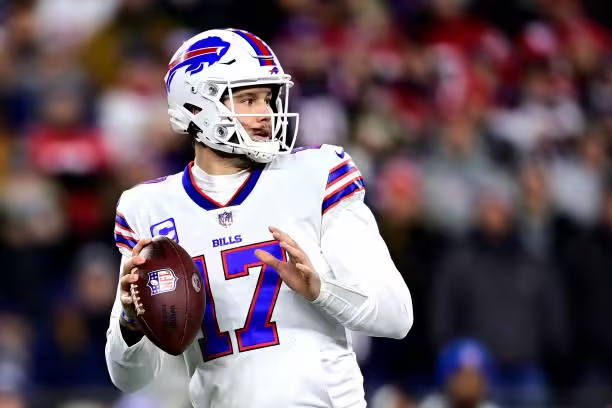
Josh Allen’s arm strength is well documented, but there is no reliable official statistic that records the longest distance of every forward pass thrown during an NFL game. The clearest measured examples come from his pre-draft workouts—not a regular-season game.
Allen is known for generating power on deep throws. To answer “How far can Josh Allen throw the football?” accurately, it is important to separate a measured workout throw, ball velocity and an estimate of how far a pass may travel in a game. They describe different things and should not be treated as interchangeable records.
What has actually been measured?
The Buffalo Bills’ official gallery from the 2018 NFL Scouting Combine notes that Allen recorded a 70-yard throw during the workout. A separate combine ball-velocity table lists 62 mph for both his left- and right-handed throws. The distance and velocity readings are different measurements: velocity describes how fast the ball leaves the hand, while distance describes how far a particular throw travels.
Important distinction: the 70-yard workout throw is not evidence that Allen completed a 70-yard pass in an NFL game, nor does it establish an official record for the longest in-game forward pass. Game throws are affected by release point, trajectory, weather and how distance is measured.
Why arm strength is more than distance
Velocity can help a quarterback fit a ball into a tight passing window, especially when a defender is closing on the receiver. But velocity by itself does not prove that a pass will be accurate or successful. Timing, placement, anticipation, decision-making and the receiver’s route all matter.
- Release and mechanics: a repeatable throwing motion helps a quarterback produce power without sacrificing control.
- Trajectory: a high-arcing deep ball and a low, driven pass may travel different distances despite coming from the same quarterback.
- Conditions: wind, weather and the direction of the throw affect a ball in flight.
- Situation: a pass in a game must also account for coverage, pressure, timing and the receiver’s position.
Can we rank Allen against other quarterbacks by throw distance?
Not responsibly using unsourced estimates. Claims that one quarterback can throw 75, 80 or 90 yards are often repeated without a common testing method or verified game record. A meaningful comparison needs the same conditions and a clear definition of distance—such as a documented workout attempt or measured ball velocity. Without that, a table of estimated “maximum throws” can give a misleading impression of precision.
Does the longest throw make a quarterback better?
No. Deep passing requires strength, but NFL quarterbacks must also read coverage, anticipate windows, protect the football and deliver catchable passes. A quarterback with exceptional arm talent still needs accuracy and decision-making to turn physical ability into consistent production.
For another view of Allen’s dual-threat game, see our companion guide to Josh Allen’s rushing stats by season.
Frequently asked questions
What is the farthest documented Josh Allen throw?
The Buffalo Bills’ official Combine gallery notes a 70-yard throw at the 2018 NFL Scouting Combine. That is a workout measurement, not a verified longest pass in an NFL game.
How fast did Allen throw at the Combine?
A published 2018 Combine ball-velocity table lists him at 62 mph throwing left-handed and 62 mph throwing right-handed.
Is the longest in-game pass distance an NFL career statistic?
It is not listed as a standard career passing category on the NFL’s usual player-statistics tables. Avoid treating unverified estimates as official records.
Does arm strength guarantee accuracy?
No. Velocity is one tool; placement, timing, reads and decision-making remain essential.
Sources
- Buffalo Bills: Bills at the NFL Combine Through the Years — official gallery noting Allen’s 70-yard throw at the 2018 Combine.
- Ourlads: Quarterback Ball Velocity at the 2018 NFL Combine — reports 62 mph for Allen’s left- and right-handed throws.
Editorial note: Reviewed and updated October 26, 2026. Unsupported estimates for in-game maximum distance have been removed.